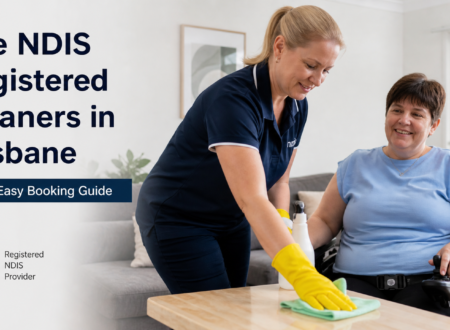



Registered vs Non-Registered NDIS Cleaners: What’s the Difference? – It’s important to understand Registered and Non-Registered NDIS Cleaners: What’s the Difference before selecting a cleaning service under the NDIS. Both kinds of services range from regular house cleaning to more specialized disability support cleaning services, which vary based on affordability, safety, flexibility, and plan type. Understanding the distinctions, statistics, and current trends in these services can help you make the right, affordable, and least risky choice for you.
What are NDIS Cleaning Services?
NDIS cleaners are service providers who assist with domestic tasks, including vacuuming, dusting, laundry, and general domestic tasks (including furnishings, cleaning, and home maintenance).
Cleaners can operate as:
- Registered NDIS providers
- Non-registered (unregistered) providers
Registered NDIS Cleaners Explained
A registered NDIS cleaner is approved by the NDIS Quality and Safeguards Commission and must meet stringent standards.
Key Features:
- They are required to undergo independent audits and quality checks
- Workers require NDIS Worker Screening Checks
- Must follow NDIS Practice Standards and Code of Conduct
- Eligible to work with NDIA-managed, plan-managed, and self-managed participants
- Pricing generally adheres to the NDIS Price Guide
Pros:
- Greater safety and accountability
- Appropriate for complex or high-risk needs
- Claims are easier (providers can bill NDIS directly)
Cons:
- Less flexibility in pricing and services
- They usually have higher administrative expenses
Non-Registered NDIS Cleaners Explained
Non-registered cleaners are not approved by the NDIS. NDIS participants can independently select and purchase a non-registered cleaner.
Key Features:
- Not independently audited by the NDIS Commission
- Must still comply with the NDIS Code of Conduct and Australian laws
- Can only be used with plan-managed or self-managed participants
- Offer flexible pricing and customized services
Pros:
- More flexible and personalized service
- Often cheaper
- Easier to find local or independent cleaners
Cons:
- Less formal supervision
- Participants must verify quality and safety
Key Differences at a Glance
| Feature | Registered Cleaners | Non-Registered Cleaners |
| Approval | NDIS Commission approved | Not officially registered |
| Compliance | Strict audits & standards | Basic legal compliance |
| Plan Eligibility | All plan types | Only self/plan-managed |
| Pricing | Fixed by NDIS guidelines | Flexible pricing |
| Oversight | High | Moderate |
Important Statistics You Should Know
- Registered NDIS providers are a small proportion (6%), with the remaining 94% being non-registered.
- In Australia, there are more than 17,000 registered providers and more than 257,000 unregistered providers.
- Many of the basic services, such as cleaning, are provided by unregistered providers.
These figures highlight the dominance of non-registered providers in delivering NDIS services. They collectively deliver a significant portion of NDIS services.
Trends in NDIS Cleaning Services 2026
- Growth of Independent Cleaners
More participants are dissatisfied with existing options and prefer local, independent, and flexible professionals.
- Regulatory Changes
Starting from July 2026, certain high-risk services (such as Supported Independent Living) will be required to register.
- Increased Demand for Custom Cleaning
Participants are seeking tailored services like:
- Disability-friendly cleaning
- Use of environmentally friendly cleaning products
- Deep cleaning for health requirements
- Shift Toward Plan Management
Many participants choose plan-managed funding to access both types of providers.
Choosing Between Registered and Non-Registered Cleaners
Choose Registered Cleaners If:
- Your plan is managed by the NDIA
- You require high-risk or specialized cleaning
- You like regulated and audited services.
Choose Non-Registered Cleaners If:
- You desire more flexibility and lower costs
- Either you are self-managed or plan-managed
- You prefer personalized services
Common Misconceptions
“Registered providers are always better than non-registered providers.”
That’s not quite accurate. Registered providers tend to be more compliant than non-registered providers, but an experienced, reputable non-registered provider can also deliver high-quality, personalized services.
Conclusion
Knowing the differences between Registered vs Non-Registered NDIS Cleaners can make it easier to select services that are suitable for your needs, financial situation, and plan type. Both types offer specific benefits, but it all depends on your personal requirements.
For a comprehensive end of lease clean, with flexible appointment options, please contact Quality Bond Cleaning. They provide reliable services that meet high industry standards. They ensure a safe, mess-free experience for both commercial and residential.
FAQs
Is it possible for me to employ a non-registered NDIS cleaner?
Yes, but only if your plan is a self-managed or plan-managed plan.
Are registered cleaners safer?
They are subject to more rigorous rules and audits, which usually makes them more compliant and accountable.
Are non-registered cleaners cheaper?
Yes, in most cases, they are cheaper because they are not bound by NDIS pricing limits.
Are there rules for non-registered cleaners?
Yes, they have to comply with the NDIS Code of Conduct and Australian consumer laws.
What is the best for cleaning your house regularly?
Most participants use registered cleaners regularly. However, non-registered cleaners are also popular for general cleaning.